Sermoni Wants to Give Pastors Their Saturdays Back
The new ministry preparation assistant helps pastors turn prayer, study, and emerging sermon ideas into organized, preach-ready messages without handing the pulpit over to technology.
It is Saturday night, and the sermon is technically "coming together," which is church language for having 17 browser tabs open, three pages of handwritten notes, two unfinished illustrations, one main point that still feels suspiciously like four main points, and a spouse who has already asked, "Are you almost done?" more than once. The pastor has prayed, studied, read the passage repeatedly, and probably already knows there is a message somewhere in the text. The problem is not always receiving the message. Sometimes the real struggle is organizing everything already stirring in the heart and mind into a clear structure that can actually be preached on Sunday morning.
That is the problem Sermoni was built to solve. Created by HealthyChurch.systems, Sermoni describes itself as a ministry preparation assistant rather than an automatic sermon generator. It works through a guided conversation with the pastor, asking about the biblical passage, central message, teaching context, desired response, illustrations, and real-life applications. As the pastor answers, Sermoni begins organizing those thoughts inside a working message outline.
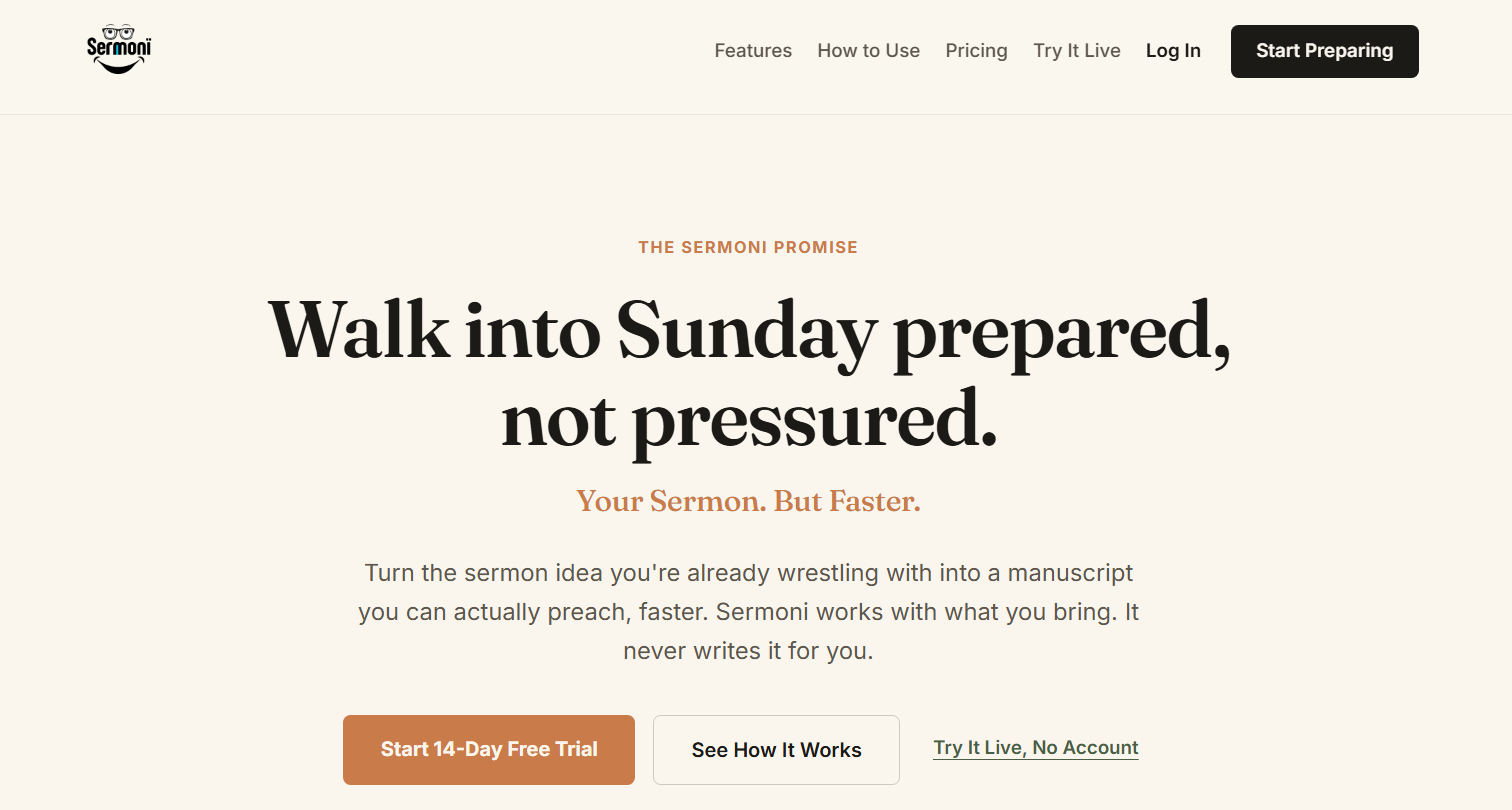
The distinction matters because Sermoni is not designed to press a button and produce a generic sermon filled with borrowed passion, questionable theology, and an illustration about climbing Mount Everest that the preacher has never climbed. The pastor brings the study, conviction, understanding of the congregation, and sense of spiritual responsibility. Sermoni helps bring order to what the pastor is already carrying. Its promise is simple: walk into Sunday prepared, not pressured. That is an attractive promise for pastors who genuinely love preaching but could do without the weekly panic that sometimes comes with preparing to do it.
First, Let's Address the Obvious Question
Whenever technology and preaching appear in the same sentence, some church leaders become understandably cautious. Should software have any role in sermon preparation? Could pastors become too dependent on it? Will every sermon eventually sound the same? Can technology understand theology, pastoral care, spiritual discernment, or what a particular congregation needs to hear?
Those are fair questions, and Sermoni's answer is that technology cannot hear from God and should never assume the role of the shepherd. The platform repeatedly emphasizes that the pastor remains responsible for the message and that Sermoni works with material the pastor has already studied, prayed through, and supplied. That makes the experience less like asking a machine to preach and more like sitting across from a thoughtful ministry assistant who keeps asking useful questions. What passage are you teaching? What continues to stand out? What do you believe your people need to understand? What is the central truth? How should listeners respond? Which situations in the congregation need to be addressed? The assistant does not receive the burden of the message. It helps the preacher unpack it.
For pastors who already use Bible software, digital commentaries, word-processing programs, voice notes, online research, sermon archives, and presentation software, Sermoni is not a complete departure from normal preparation. It is another tool in the process, but one specifically designed around the way sermons, lessons, Bible studies, devotionals, and group discussions are developed.
What Sermoni Actually Does
The easiest way to understand Sermoni is to imagine two workspaces operating together. On one side is a conversational preparation assistant. On the other is the developing message. The pastor begins a new project and chooses the type of material being prepared, such as a sermon, Bible study, Sunday School lesson, small-group discussion, devotional, or teaching session. Sermoni then begins asking questions. Rather than presenting the pastor with a long and intimidating form, it moves through the preparation process conversationally. The pastor identifies the passage, explains what is emerging from the text, clarifies the main idea, and considers the response the message should produce.
As those answers are given, the workspace begins taking shape. Points are organized, sections are developed, applications can be added, illustrations can be explored, and discussion questions can be created. The pastor can edit, delete, rewrite, move, or replace anything inside the workspace. The platform treats its suggestions as starting points rather than untouchable final copy. That is important because no pastor should surrender ownership of the message simply because the wording sounds polished.
When the message is ready, the user can review it, save it to a Teaching Library, and export a clean PDF. Projects save automatically, allowing pastors to leave the work and return later without starting over. That last feature may not sound dramatic until you remember how many sermon notes have disappeared inside abandoned notebooks, outdated laptops, email drafts, cloud folders named 'New Folder 6,' and documents titled 'Sermon Final FINAL Use This One.' Sermoni keeps the work organized in one searchable teaching environment.
A Hands-On Sermoni Walkthrough
A pastor does not need to begin with a polished title, three alliterated points, and a closing celebration already humming in the background. The process can begin with something as simple as: "I keep coming back to Mark 4 and the disciples being afraid in the storm." That is enough to start. Sermoni can then ask what stands out in the passage, what tension the pastor sees, what the congregation may need to hear, and what kind of response the message should produce. The platform does not require the user to arrive with a completed main point. The guided conversation is intended to help clarify it.
The pastor might respond: "My people have been treating fear like evidence that they do not have faith. I want them to understand that faith is not pretending the storm is not frightening. Faith is trusting Christ while the storm is real." Now there is substance. Sermoni can help shape that conviction into a central message, but the idea came from the preacher's understanding of the text and the people.
From there, the pastor can begin building the movement of the sermon. The outline might develop around ideas such as: The storm was real. The disciples' fear was understandable. Jesus' presence did not prevent the storm. Jesus' authority was greater than the storm. Faith does not deny fear. It decides who has final authority. Sermoni can organize those thoughts into sections and help form transitions between them. The pastor can then adjust the language until it sounds natural in that particular pulpit.
Success is a pastor saying, 'I understood my message earlier this week. I was more present with my family. I was not panicking Saturday night.'
Application Is Where the Message Meets the Room
A sermon about storms can become vague very quickly. Sermoni can help the pastor identify specific life stages and situations that may need application. That could include the parent worried about a child, the entrepreneur facing an uncertain quarter, the church member awaiting medical results, the family processing grief, the ministry leader approaching burnout, or the believer who feels guilty for being afraid.
Technology cannot know the congregation the way the pastor does. It was not present during the counseling session, hospital visit, leadership conflict, or quiet conversation after service. It can, however, prompt the pastor to think more carefully about who may be listening and where the truth of the text should meet real life. That may be one of Sermoni's most practical benefits. It encourages pastors to move beyond explaining the passage and consider how the passage should affect the people receiving it.
Supporting Material Without Losing Responsibility
Pastors can also request illustrations, cross-references, commentary support, and discussion questions. Sermoni indicates that its commentary material comes from public-domain works, including Matthew Henry, Jamieson-Fausset-Brown, Adam Clarke, and John Gill. Sources are cited within the platform so the preacher can see where supporting information originated.
That citation feature is important because no pastor should repeat a historical, theological, or textual claim simply because a digital assistant presented it confidently. Sources should be reviewed, context should be checked, and the biblical text should remain central. Sermoni gives the user a place to begin, but the preacher remains responsible for accuracy, interpretation, theology, and pastoral application. That responsibility becomes even more important when the material sounds especially good. Strong wording can create the illusion that something is automatically true. Pastors must still read, think, examine, and verify.
The Final Step Is Making It Sound Like You
No pastor should export the first draft and head directly to the pulpit. Read the message aloud. Remove phrases you would never say. Strengthen sections that feel thin. Check whether the interpretation remains faithful to the text. Ask whether the application is pastoral rather than performative. Determine whether the introduction takes too long to reach the real issue, and make sure the conclusion moves people toward a meaningful response.
Technology can compose sentences, but only the preacher knows whether those sentences belong in that preacher's mouth. The final sermon should sound like the pastor who will actually stand before the people. It should reflect that pastor's theology, cadence, personality, convictions, and understanding of the congregation.
Sermoni Is Not Only for Sunday Morning
One of the platform's strongest possibilities is using the same week's study across several teaching environments. A pastor may prepare the Sunday sermon from a passage and then develop a Wednesday Bible study, small-group discussion guide, Sunday School lesson, leadership devotional, youth conversation, digital devotional, or congregational follow-up email from the same broader study. Sermoni supports multiple teaching formats, each using questions tailored to that particular setting.
That can help churches stop treating every ministry environment as a completely separate content emergency. The Sunday sermon should not simply be copied and pasted into every room. A sermon, Bible study, Sunday School lesson, and small-group discussion require different approaches. Still, one biblical theme can serve the congregation throughout the week. The pulpit introduces the truth. Bible study examines it more deeply. Small groups discuss it. Leaders apply it. Families revisit it. The congregation begins moving together rather than receiving unrelated messages from every ministry.
For smaller churches, that kind of alignment can be especially valuable because the same pastor may be responsible for preaching Sunday, teaching Wednesday, preparing leadership devotionals, and supplying material for ministry teams.
Sermoni helps pastors develop a Sunday message and then carry that same biblical truth into Bible studies, small groups, leadership devotionals, and family conversations — one week of preparation, multiple rooms of impact.
Building a healthy teaching culture also requires strong organizational foundations. Read how to build a healthy church culture from the inside out.
Not ready to try software yet? See the 5-step framework for preaching a powerful sermon on How To Build A Sermon.

Meet the Founder
Sermoni was created by D. Brandon Campbell, a former senior pastor, ministry leader, author, operations professional, and technology builder. Campbell's Founder's Story explains that he preached almost every Sunday for seven years while serving bi-vocationally. He later returned to technology school, earned 11 technology certifications, and began building the tool he wished he had possessed during those demanding years of weekly preparation. Christianpreneur Magazine spoke with Campbell about why he built Sermoni, what he believes technology should never do, and why saving preparation time is about more than convenience.
The Founder Interview
CP MAG:You preached weekly for seven years while also working outside the church. What did that season teach you about sermon preparation?
CAMPBELL:It taught me that sermon preparation does not happen in a vacuum. You can love God, love preaching, and take the responsibility seriously while still having a job, family responsibilities, meetings, counseling needs, administrative work, and a life outside the pulpit. When you are bi-vocational, every hour matters. You may know what God is saying through the passage, but organizing it into a message can consume the part of the week you wanted to give to your family or the people you serve. I built Sermoni around that reality.
CP MAG:Was the goal to help pastors write more sermons?
CAMPBELL:Not more sermons. Stronger preparation with less unnecessary pressure. The goal is not to help somebody produce religious content faster just for the sake of producing it. The goal is to help pastors take what they have already studied and prayed through and move it into a clear, usable structure. Sometimes the message is there, but the pastor is staring at scattered notes trying to figure out how everything fits together. Sermoni helps with that part.
CP MAG:Why are you so intentional about saying Sermoni does not replace the pastor?
CAMPBELL:Because the pastor is the shepherd. Technology does not know the people. It was not present for the hospital visit. It does not understand the history of the congregation. It cannot discern what the Holy Spirit is pressing on the pastor's heart. I never wanted to create something that pretended software could do that. Sermoni should support pastoral preparation, not take pastoral responsibility away.
CP MAG:Some people are concerned that tools like this could make sermons generic. How do you prevent that?
CAMPBELL:Sermoni begins with what the pastor brings. It asks questions. It learns the church's doctrine, the pastor's preferred tone, and the Bible translation being used. The pastor can edit everything. If you disagree with a suggestion, remove it. If the language does not sound like you, change it. The substance should come from the pastor's prayer, study, conviction, and knowledge of the people. A generic message usually happens when someone asks technology to create something from nothing. Sermoni is designed to work from the real substance the pastor has already developed.
CP MAG:What does success look like to you?
CAMPBELL:Success is not hearing, 'The software preached a great sermon.' Success is a pastor saying, 'I understood my message earlier this week. I was more present with my family. I was not panicking Saturday night. I walked into Sunday clear about what I was supposed to say.' That is why one of the ideas behind Sermoni is helping pastors close the laptop sooner. Time saved is not only productivity. It can become rest, presence, pastoral care, family time, or additional study where it is genuinely needed.
CP MAG:Why combine ministry experience with technology?
CAMPBELL:I understand both worlds. I know what it feels like to carry the responsibility of the pulpit every week, and I also learned how technology can organize complicated processes. Sermoni is those two experiences meeting in one place. I am not a technology person guessing what pastors need. I built the tool I needed when I was preaching weekly.
What We Like About Sermoni
The strongest part of Sermoni is its philosophy. Many technology products begin with the assumption that faster generation is always better. Sermoni begins with the assumption that the pastor's thought process matters. The conversational workflow encourages reflection rather than presenting a blank document and expecting immediate brilliance. The split between conversation and workspace also makes sense. Pastors can think through the message in ordinary language while watching the structure develop. That is especially helpful for preachers who think best by talking through ideas rather than staring at an empty page. The ability to prepare several teaching formats from the same study is another major strength. Smaller churches often depend on one pastor to produce nearly every sermon, lesson, devotional, and leadership conversation. Sermoni can help organize that work without pretending each environment should receive an identical version of the same material. The Teaching Library addresses another common problem. Pastors can spend years creating valuable biblical content but have no useful system for retrieving it. Sermoni gives that material a more organized home. The cited public-domain commentary support is also a responsible feature, provided users continue checking original sources and biblical context. Most importantly, Sermoni continues reminding users that final responsibility belongs to the pastor. That guardrail should remain central as the platform grows.
What Pastors Still Need to Bring
Sermoni can help organize a message, but pastors should not arrive empty-handed. They should bring the biblical text, prayer, an honest attempt to understand context, theological conviction, knowledge of the congregation, awareness of the questions people are asking, and the pastoral burden behind the message. They should also bring the willingness to delete anything that is clever but unfaithful, the discipline to verify supporting information, and the confidence to preserve their own voice. A kitchen appliance can help prepare a meal, but it cannot care whether the family is nourished. The tool matters, but the person using it matters more.
Who Sermoni Is Best For
Sermoni could be especially useful for bi-vocational pastors balancing ministry with outside employment. These leaders may benefit most directly from a structured preparation process that reduces time lost to organizing scattered material. It may also be valuable for small-church pastors who prepare nearly every sermon, Bible study, devotional, leadership meeting, and special service. Church planters may find it useful because they often preach while simultaneously managing fundraising, outreach, setup, follow-up, volunteers, operations, and community relationships. Teaching pastors developing sermon series, classes, discipleship material, and group discussions can use it to keep related work connected. Sunday School and Bible study teachers may benefit from guided questions that help clarify lessons, applications, and discussion points. Pastors who think out loud may find the conversational structure especially helpful. Some preachers struggle with blank pages but become clear when someone asks the right question. It may also serve pastors who have years of scattered material and need to begin building a more organized teaching archive.
Who Should Use It Carefully
Sermoni may not be a good fit for someone looking for a button that produces a complete sermon without study. That expectation conflicts with the platform's stated purpose. It should also be used carefully by pastors who tend to accept the first well-worded suggestion they receive. Clear prose is not the same as sound interpretation. Users should review commentary sources, cross-references, historical claims, theological statements, and applications. Churches may also want to establish basic guidelines for responsible use, particularly where there are existing policies concerning generated content, intellectual property, or pastoral disclosure. The best standard is simple: use technology to strengthen the work you are responsible for doing, not to pretend you completed work you avoided.
Sermoni Pricing
At the time of publication, Sermoni offers a 14-day trial. The current founding-church offer is $29 per month, locked in for participating churches that join during the founding period. The published standard rate is $49 per month. Sermoni says the plan includes its message-preparation features, Teaching Library, church-specific settings, and eventual access to GROWTH, another HealthyChurch.systems product focused on church-health guidance. Because launch pricing and availability may change, readers should verify current terms directly on the Sermoni website before subscribing.
How to Get the Best Results From Sermoni
Pastors will likely get the strongest results by doing some study before opening the platform. They do not need a completed outline, but they should read the passage and begin observing what is happening. They should also answer the questions honestly rather than trying to sound impressive. Sermoni works best when the user explains what they genuinely see, believe, and wrestle with. Specificity matters. 'The church needs encouragement' is broad. 'Our caregivers are exhausted and beginning to feel guilty for being tired' gives the application somewhere to go. Pastors should ask for options rather than treat every suggestion as a final answer. Illustrations, structures, transitions, and applications should be evaluated. Reading the message aloud is essential. If it does not sound like the preacher, it is not ready. Sources should be checked, projects should be saved intentionally, and the Teaching Library should be organized with titles and details that make future retrieval easier. Perhaps most importantly, pastors should use the saved time on purpose. If Sermoni saves three hours, the goal should not automatically be to spend three additional hours unnecessarily editing. Close the laptop. Call a member. Take your spouse to dinner. Attend your child's event. Rest. The saved time is part of the benefit.
The Bigger Idea Behind Sermoni
Sermoni may be a sermon-preparation product, but its deeper argument is about pastoral health. Pastors frequently carry the spiritual and emotional needs of entire congregations while functioning inside weak systems. They preach, counsel, plan, lead staff, resolve conflict, supervise volunteers, raise money, manage facilities, attend community events, respond to emergencies, and attempt to remain present at home. Technology cannot solve all of that, but it can remove some friction. A tool that helps a pastor organize a message sooner will not heal burnout by itself. It may, however, return a few hours that were being lost every week. A few hours each week becomes more than 100 hours in a year. That time can become rest, family, prayer that is not attached to producing something, pastoral care, or space to think about the health of the church beyond the next sermon. That may be Sermoni's most compelling feature. It is not simply trying to make pastors faster. It is trying to give some of their week back.
Recommended Reading for the Preacher's Library
Practical wisdom on preparation, exposition, delivery, pastoral integrity, and the weekly responsibility of preaching.
A long-respected preaching resource focused on developing and communicating the central idea of a biblical passage with clarity.
Reflections that help pastors reconsider ministry as spiritual vocation rather than constant religious production — an especially appropriate companion to a tool intended to help leaders reclaim time and presence.
A digital paper tablet pastors who prefer handwriting their initial observations can use to capture study notes before bringing those thoughts into Sermoni.
Christianpreneur Magazine may earn a commission from qualifying purchases made through Amazon affiliate links at no additional cost to the reader.
Pastors do not always need someone to give them a sermon. Sometimes they need help organizing the one already taking shape through prayer, study, experience, and pastoral care. Sermoni is built for that middle space between the first spark of a message and the moment the preacher is ready to deliver it.
Visit SermoniChristianpreneur Magazine may earn a commission from qualifying purchases made through Amazon affiliate links at no additional cost to the reader.
More in Pastors
See all
5 Signs Your Sermon Prep Process Is Broken, and How to Fix It
If Saturday night still finds you staring at a blank outline, the problem probably is not your discipline. It is your process.
Michael Reynolds · 7 min
Pastor of the Month: Rich Villodas of New Life Fellowship
The Brooklyn-born lead pastor of New Life Fellowship is helping churches rediscover a slower, deeper, more emotionally healthy way to follow Jesus.
Marcus Reed · 7 min
How Pastors Can Save 10 Hours Every Week Without Sacrificing Biblical Integrity
Ministry Was Never Meant to Be a Race Against the Clock.
Michael Reynolds · 6 min